
AI-authored 2D character rigs from one anime painting, verified before they
are written. rig-parts generates no images. The painting and See-through layers
come from models the user runs on their GPU or a web demo; this package ships no
weights. The optional comfy adapter drives the user's own ComfyUI host and models.
rig-parts takes a single character painting and the layers
See-through decomposed it into,
merges them into measured rig-space parts, authors weighted meshes, bone chains
and a looping idle over them in rig-c's
spec, and hands that spec to rig-c to compile, gate, pack, render and check.
It is built for agents that cannot see the image: every stage prints named,
numeric findings, a refusal names the object, the value found and the value
required, nothing is written after a red, and no value is invented where the
input is silent.


The painting was generated for this repository with a public checkpoint (Hassaku XL
(Illustrious) v1.3 Style A, by Ikena, Fair AI Public License 1.0-SD) and no LoRA, on a
pose that holds the hands apart, then given one hand-detailer pass; its generation
record, See-through layers and licence are in
rig-c/examples.
See-through ran twice, once on the whole figure and once on a square head crop.
Then one command: rig-parts build --loop --lead-in 3. The proposer's bones, meshes,
regions and motion were used as proposed but for one correction, written in the
config beside the values it replaced: the two outer skirt chains were moved out to
0.8 of the skirt's half-width (the proposal's, within 90 px of the centre of a skirt
449 px wide, swung it about its middle and failed TIP_OVER_ROOT, 0.442
against 1.4725; moved, 2.425). One input-stage edit: hair_back is taken
from the full run, because the twin tails leave the head crop sideways (a plan edit).
check printed, verbatim:
50 assertions: 24 measured (24 passed, 0 failed), 26 skipped, 0 not in profile "rig-play"
loop: idle 41 frame(s) at 12 fps, f0000 vs f0040 (t = 3.333333333333333s) with the rig's 29 physics constraint(s) left out (named on the `loop physics:` line; rendered with them, the ends need not meet — `build --loop --lead-in <n>`): max |d| 0 (0 required)
seam: setup pose at 654x1216, scale 0.9438: mean |d| 0.147 (<= 1.0), 0 px over 40, 0.00 rig px (the count / s²; <= 50), 0 px over 80 (reported)
pack: skeleton.png 1051x972, 23 region(s), 96.9% covered, padding 2, page edges free, shape polygon
The loop is that build's indexed APNG, 40 frames at 12 fps, 703,909 bytes, one
256-entry palette at a measured error of max 71, mean 0.636 per channel over every
frame (the lossless APNG beside it, the exactness record, is 4,449,233 bytes; the
GIF, at the same error, 760,058). The rig's hair, skirt, sleeves, bows and earrings
carry physics, which rigc's render starts from rest, so the idle is played three
periods ahead and the loop is the fourth: the frame one period after its first differs
from it by max 1 level, 0 px over 40 (--lead-in). Frame 29 (2.417 s) is the
closed eye: the blink holds for 0.084 s, one 12 fps frame rounded up; the painting is
shown at half size, resampled and written by this package's PNG codec (nothing here
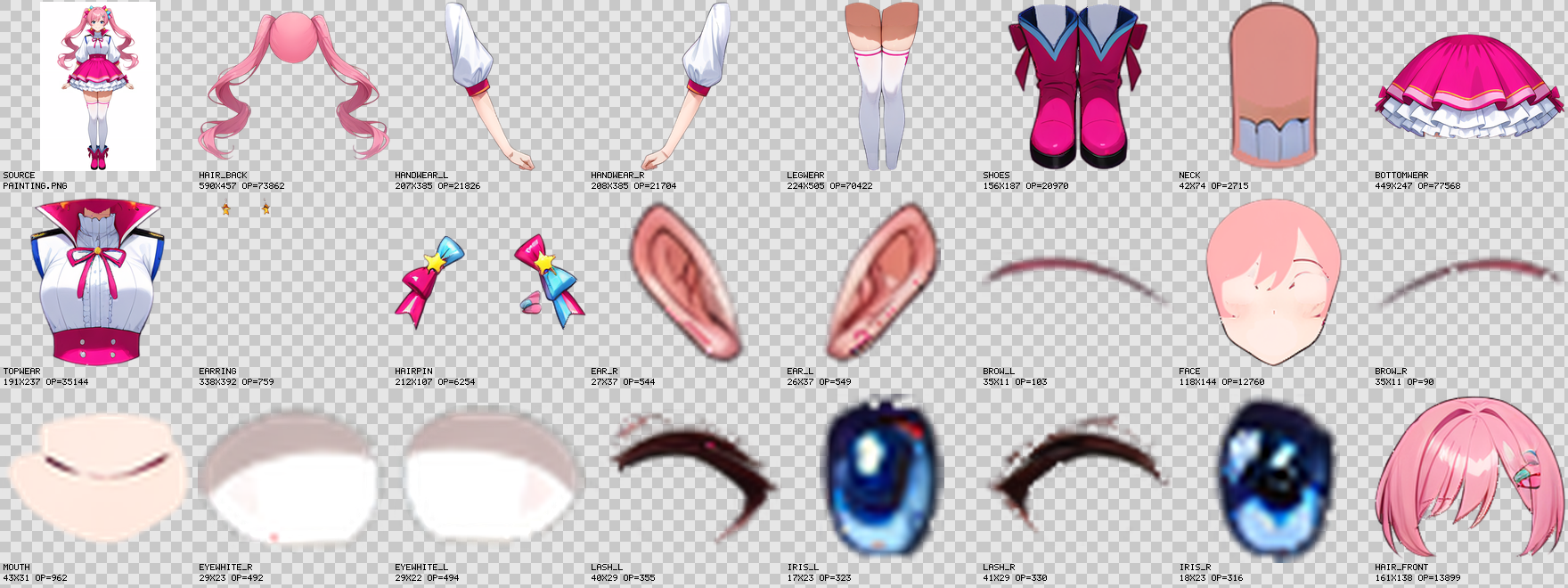
encodes JPEG). rig-parts sheet made the contact sheet. Its
expected/ is this port's own build (examples/demo).
The hanging element, examples/scarf: Pony Diffusion V6 XL, no LoRA, a very long
red scarf whose ends hang free, and the first character run through this pipeline
with its proposal used unedited — the only hand corrections are four
assemble.patches, each answering an uncovered hole line.
check passes 9 of 9 with every mesh on the lattice and with every mesh
switched to the contour mode. It has no reference output: its expected/
is this port's own build (examples/scarf).
Two more characters are tracked as fixtures and not shown:
examples/reference-demo and examples/reference-sample, the two
the reference implementation ran (published as demo and sample
until issue #227, which took the clasped-hands painting off display). Their
expected/ is that implementation's own output, which the selftest holds
this port to.
- One painting — a PNG of one character that a rig can be cut from: front view,
arms clear of the body, hands apart and open, legs apart with a gap, on a plain
light background. docs/PAINTING.md says what each requirement
is for and what breaks without it, gives one generation recipe, and describes
rig-parts painting, which checks a painting against its body-18 joints before See-through runs. To set up the machine that makes the painting and the layers, see rig-c/getting-started. - Its See-through layers, twice: one run on the whole figure (the painting padded
white to a square) and one on a square crop around the head, because the eyes of a
full-figure run are too small to separate. Either form See-through reaches you in
is read:
- the ComfyUI wrapper form — a directory holding
layers.jsonand one RGBA PNG per layer (flat beside the manifest, or underparts/<tag>.png); - an upstream
.psd— one pixel layer per tag, the layer name being the tag, the stacking order being the draw order.
- the ComfyUI wrapper form — a directory holding
- A character config (
config.json) — the part plan, the head box, the bones, which bones may pull which layer, the idle's sines, and optionallyconstraintsin rig-c's own rig-spec shape (ik, transform, path, physics, slider), handed to rigc as written once every bone they name resolves; a scene target is a bone underroota constraint names.src/config.tsis its schema and documents every field; the loader refuses an unknown or a missing field by name, and reads nothing undernote, a<name>_note(a string) or a key beginningx-(any JSON — a project's own records, such as a past build's gate results). docs/AUTHORING.md says where each value comes from.
rig-parts build ends the way a Spine editor export does — with one packed atlas
page (issue #2):
path under --out |
what |
|---|---|
check/build/skeleton.json, skeleton.atlas, skeleton.png |
the artifact — Spine 4.3 skeleton data and one packed page, written by rigc build --pack --page-edges free --pack-shape polygon and gated under rig-play (named spine-html before rig-c 2.50.0), which holds every rule spine measures (on reference-demo, rigc 2.1.3 and 2.10.1: the 14 rules validate --profile spine measures are among the build's 24; 16 are not in spine) |
parts/*.png, parts.json, recomposite_rig.png, recomposite_error_rig.png |
the loose parts, each cropped to its alpha box; the record of where every part came from, how many of its pixels were re-taken from the painting, and the recomposite's uncovered holes with their boxes; the flat stack of parts; its error map — red where no part covers a pixel the painting has, blue where a part covers it in the wrong colour |
rig/ |
rig.json and motion.json in rig-c's spec, mesh_report.json, the padded images/ |
check/ |
both gate files verbatim, the idle's frames and their geometry.json (skinned vertices per frame), contact.png, motion_heat.png, check.json (with pack_mode, the --page-edges and --pack-shape the page was packed under) |
idle.png, idle-indexed.png, idle.gif |
with --loop: the idle as a lossless APNG (the exactness record), an indexed APNG with one shared palette (the small one) and a GIF; the last two print their palette error |
The last lines of a green build are the pack line, printed beside the Spine example
export's spineboy.png as a yardstick (a reference, not a bar), and the three
artifact paths — here for examples/reference-sample:
build: PASS — the packed atlas is the artifact; parts/ and rig/ are the intermediates it was made from
  pack: skeleton.png 477x1151, 20 region(s), 95.0% covered, padding 2, page edges free, shape polygon; page opaque 54.8% (alpha > 0) — spineboy yardstick 1024x256, 40 region(s), 45.8% opaque (alpha > 0), a reference and not a bar
  out/check/build/skeleton.json
  out/check/build/skeleton.atlas
  out/check/build/skeleton.png
The page's edges are free by default: rigc picks the least-area page the parts need,
not the next power of two. On the two reference examples, packed by rectangles, that is 967x1338
and 479x1166, where a power-of-two page is 1024x2048 and 512x2048, and covered goes from 56.3 % to 91.2 % and
from 49.7 % to 93.4 %. The cost is the one rigc's help states: "region attachments
sampling within 1 LSB of the loose build rather than exactly". Measured on both
examples, every idle frame stays within 1 level of the power-of-two build's. The atlas says
filter: Linear, Linear and has no repeat line, so --page-edges pot is for a
consumer that mipmaps or repeats the page; it writes exactly the page builds wrote
before the flag existed. The measurements are in
AUTHORING §5, Page edges.
The pack shape is polygon by default (rig-c 2.1): a region only meshes draw is
packed by its emitted hull, so a neighbour may sit inside its rectangle where the hull
is not; a region attachment stays its rectangle. On the two examples that takes the
free page from 967x1338 to 922x1348 (covered 91.2 % to 95.0 %, 3.9 % less area) and
from 479x1166 to 477x1151 (93.4 % to 95.0 %, 1.7 % less), at the cost class free
already has: every idle frame within 1 level of the rect build's, and no figure in
check.json but pack_mode moves. --pack-shape rect writes the page and atlas
0.7.0 wrote. The measurements are in
AUTHORING §5, Pack shape.
The packer is rig-c's, and no other: a packed region is a lossless copy, and an atlas written by anything else would have no oracle behind it.
| stage | tool | what it owns |
|---|---|---|
| painting + See-through layers → parts and specs | rig-parts (npm @rig-c/parts) |
the merge of two runs, the measurements, the rig spec and motion spec |
| specs → Spine skeleton data | rig-c (npm rig-c) |
compile, the gate (rigc's own validator in an install; the round trip through spine-core where the runtime is beside it, as in this repository's CI), the named assertions, the packer, the renderer |
| skeleton data → a page | rig-play (npm @rig-c/play; formerly spine-html), a sibling project |
a DOM renderer; rigc's rig-play profile is its policy, and every build here is gated under that profile as well as under spine |
rig-parts never writes Spine data itself. Everything on disk under check/build/
was written by rig-c after its own gate passed.
See-through is required; how you run it is not. rig-parts does not vendor, embed or redistribute See-through code or weights — run it by any of these and point rig-parts at what it wrote:
| Route | Where | Output rig-parts reads |
|---|---|---|
| Hugging Face Space | 24yearsold/see-through-demo (ZeroGPU) | the .psd it produces; upload st_input_full.png, the white-padded square from inputs, for the full run, and st_input_head.png for the separate head run |
| ModelScope demo | ljsabc/See-Through, linked from the upstream README | the .psd it produces |
| Upstream CLI | python inference/scripts/inference_psd.py --srcp <image> --save_to_psd in a checkout of shitagaki-lab/see-through |
the .psd in workspace/layerdiff_output/ |
| ComfyUI wrapper | jtydhr88/ComfyUI-See-through on your own ComfyUI box; the optional comfy adapter (rig-parts comfy seethrough) drives it |
the layers.json + PNGs it writes |
Use the square inputs outputs on the Space too. Its app calls apply_layerdiff,
which calls center_square_pad_resize.
That preprocessing function
pads a non-square upload before resizing; the centre-crop reported in
#356 is not the current source path.
st_input_full.png supplies the explicit white padding that rig-parts maps back
to the original painting. This is a source inspection, not a new demo run.
The head run is needed on every route that was read. See-through's model
already separates the head in a second stage of its own: it crops the head the
first stage found, runs the face tags on that crop at the same resolution, and
pastes the result back resized to the full image's scale. So the face comes
back at the full run's pixel density whichever route ran it, and the separate
head run on st_input_head.png is what gives the eyes more pixels
(read on 2026-09-28 at see-through a25a549 and wrapper 0.5.0 98d754b):
- Hugging Face Space — the same two-stage code, with
resolutioncapped at 1280 (768 by default): the head run is still needed. - ModelScope demo — its code was not read, so what the head run adds on that route has not been measured.
- Upstream CLI — the
.psdframe is theresolution-sided square the first stage ran on (1280 by default), and the head stage is pasted into it at that scale: the head run is still needed. - ComfyUI wrapper —
SeeThrough_GenerateLayersruns both stages with no input to change the second, at mostresolution2048, which on the examples' 2432 px square is 1.19 source px per layer px against 0.77 and 0.47 for their head crops; at the 1024 the examples ran, the full run's right eye white is 22×13 px and the head run's 60×38: the head run is still needed.
See-through is required; ComfyUI is not. The wrapper is one route among
four, and rig-parts comfy is only a convenience for that route: every
stage after See-through reads files, whichever route wrote them. On the two
reference examples each run took 171–199 s through the wrapper, and on the demo 179 s (each run's
meta.json, in rig-c/examples).
rig-parts inputs --source painting.png --config config.json --out <dir>cuts the two images See-through is fed: the painting centred on a white square
(st_input_full.png) and, when the config sets seethrough.head_box, that
box at its exact size (st_input_head.png). Pure raster, no GPU.
For a user who has a ComfyUI box, two commands drive it; nothing else in the pipeline needs one:
rig-parts comfy paint --config config.json --out <dir> --host http://<box>:8188
rig-parts comfy seethrough --image st_input_full.png --out layers/full --host http://<box>:8188
comfy paint asks the user's models to generate painting_<seed>.png from the config's inline
generation block — checkpoint, LoRAs, sampler, and an optional OpenPose
control skeleton it draws itself — and records the prompts verbatim beside it.
comfy seethrough runs the ComfyUI-See-through
wrapper on one image and writes the wrapper form layers reads. The host comes
from --host or COMFY_HOST and has no default; before anything is uploaded
the graph is checked against the box's /object_info, so a missing node class
or model is refused by name, and the adapter waits for an empty queue rather
than queueing behind someone else's job.
The painting graph uses 4x-AnimeSharp.pth, then Lanczos resizing. The
creator's card
declares CC BY-NC-SA 4.0. When generation.control is set, the intended OpenPose
ControlNet is xinsir/controlnet-openpose-sdxl-1.0,
whose card declares Apache-2.0. Install its diffusion_pytorch_model.safetensors
on the host as controlnet-openpose-sdxl-1.0.safetensors, or select its installed
filename with generation.control.model. A filename alone does not verify the
weights. NOTICE pins the
sources and records their declared terms; those declarations do not assign a
blanket licence to output images. The graph's automatic upscaler selection is
unchanged; the owner decision is tracked separately in #428.
--offload selects the wrapper's CUDA group-offload path on the ComfyUI host:
its LayerDiff and depth loaders
call enable_group_offload('cuda', ...). Omit it for a local Mac/MPS host. A Mac
running this CLI may pass it to a remote CUDA host. This describes that offload
path; it is not a claim that the remaining model stack has been verified on MPS.
The wrapper README at 98d754b
describes a combined Decompose node and names 24yearsold/seethroughv0.0.1_marigold
for depth. The shipped workflows/seethrough.json instead sends
SeeThrough_GenerateLayers, SeeThrough_GenerateDepth and SeeThrough_PostProcess,
and selects layerdifforg/seethroughv0.0.1_marigold, matching the wrapper's
implemented depth default.
Use the graph's node classes and the host's /object_info when checking the adapter.
rig-parts inputs --source painting.png --config config.json --out inputs   # st_input_full.png; the config needs assemble.rig_scale
#    See-through on st_input_full.png (external, or `rig-parts comfy seethrough`) -> layers/full
rig-parts layers layers/full                      # drawn(a>8)/opaque(a>=250) boxes, CORE body-group height in input-canvas px, WARNs
rig-parts propose --head-box --full layers/full --canvas 1664x2432
#    -> seethrough.head_box into config.json
rig-parts inputs --source painting.png --config config.json --out inputs   # now st_input_head.png too
#    See-through on st_input_head.png (external, or `rig-parts comfy seethrough`) -> layers/head
rig-parts sheet --source painting.png --layers layers/full --layers layers/head --out sheets/layers.png
rig-parts assemble --propose-plan --source painting.png --full layers/full --head layers/head --config config.json
#    -> assemble.plan and extend_below_crop
rig-parts assemble --source painting.png --full layers/full --head layers/head --config config.json --out work
#    -> work/rig: parts.json and parts/; the config holds no bones, meshes, regions or motion yet
#    -> read the `uncovered hole N:` lines and look at work/render/recomposite_error_rig.png:
#       red is painting that no part holds, and no later gate can see it
#    -> a large red hole neither run holds? add an assemble.patches entry (cut from the painting) and assemble again
rig-parts propose --parts work/rig --source painting.png --out work
#    -> proposal.json, basis.json (what each bone rests on) and render/landmarks.png; per-bone coverage lines;
#       correct it, copy bones/meshes/regions/limbs/motion/constraints/turn/motion_seams/proposed_rig_scale into config.json, each it wrote
#       (limbs only with --keypoints, constraints only with --cloth, turn only with --full/--head;
#       a limbs block left out is refused next)
rig-parts propose --parts work/rig --source painting.png --out work --from-config config.json
#    -> LINT lines; exit 1 while any remain (takes --parts, --source, --out, --from-config and optional --keypoints [--person] only;
#       proposes nothing, so --full, --head, --cloth, --write-config, --wrist-snap, --grid-rule, --only-missing and --compare are refused)
rig-parts build --config config.json --source painting.png --full layers/full --head layers/head --out out --loop
#    -> read out/check/check.json; every FAIL line names what has to change
At each step the config holds only what that step reads; the one table of what
that is, step by step, is docs/AUTHORING.md §4.
The command-order controls exercise the hand-copy route above on each fetched
example from a config holding only what the first step reads (RL01). The optional
--write-config forms below save the proposed fields; RL01 does not exercise
that flag. On demo the
proposal pasted uncorrected stops at the last step, naming its bottomwear on
CHECK_TIP_OVER_ROOT — the correction its tracked config records there, the two outer
skirt chains moved (issue #227, its README); on scarf,
since issue #262, it builds green, and on wind too. wind's config declares the cloth
recipe and its limbs, so the block runs on it again with that cloth block authored,
--cloth config.json on the drafting propose line and its tracked keypoints.json on both
propose --parts lines (RL05): it pastes limbs and constraints with the rest and gives
back the tracked config, section for section (its README).
On demo, which tracks the pose file it was painted on, the block runs again with
--keypoints on both propose --parts lines (RL03): the proposal then also drafts
limbs, the step's list carries them, and the run ends where RL01 ends. The joints
are that pose file scaled to the painting, not read off it, so this shows what the
loop carries, not where the joints are. On wind, which tracks the joints read off its
painting (keypoints.json), RL03 runs with those. The list as it stood before issue #375, four
sections, stops at --from-config naming every limb part (RL04).
propose is deliberately not a step of build: the proposal is a draft to correct
against its overlay, and a config with bones is build's input. rig, check and
loop are the same stages one at a time. docs/AUTHORING.md is
the guide an agent authors from — every config field, what to look at after each
stage, what each refusal means and which field it points at — and
skills/rig-parts/SKILL.md is the same loop as an
agent skill.
| command | does |
|---|---|
inputs --source <png> --config <json> --out <dir> |
the two images See-through is fed: the painting on a white square, and the head box's crop once the config has one |
comfy paint --config --out [--host] |
optional: generate the painting on a ComfyUI box from the config's generation block |
comfy seethrough --image --out [--host] |
optional: run the ComfyUI See-through wrapper on one image and write the form layers reads |
layers <dir | layers.json | file.psd> |
keep the existing columns (opaque_px still means alpha >8) and append source-alpha boxes drawn(a>8) / opaque(a>=250) with exclusive right/bottom; name absent boxes, report the existing body-group union height at CORE_ALPHA (>=250) in input-canvas px, and show its >8 union separately; no anatomical height, ownership/erosion or painting registration is inferred (units and rig-scale guidance) |
sheet --source <png> --layers <path>… --out <png> |
a labelled contact sheet of the painting and every layer or part |
assemble --propose-plan … [--write-config <config>] |
propose assemble.plan and extend_below_crop from the two runs, leaving out an implausible layer with a note naming the rule, naming in a note any full-run body no planned part covers, and naming every layer no row takes with why (empty, taken from the other run only, a plausibility rule; nose, never planned, with the row that lets propose read the head's pitch) |
assemble --source --full --head --config --out [--seam] [--project] |
merge the two runs into rig-space parts, parts.json, the recomposite and its error map, and list the uncovered holes |
propose --head-box --full <run> --canvas WxH [--no-back-hair] [--write-config <config>] |
propose seethrough.head_box from the full run, held inside the painting; --no-back-hair leaves the back-hair layer out of that proposal |
propose --parts --source --out [--compare <config>] [--write-config <config> [--only-missing]] |
propose bones, meshes, regions and an idle; draw the overlay; print, per bone, which check read it or that none did and why (its role, its kind of segment), and write basis.json beside the proposal — what each bone rests on (a joint, a part's mask, a ratio, other bones) and, with --compare, whether the config's bone differs |
propose … --keypoints <file> [--person <id>] |
read a posed figure's joints from one explicit file (space, image size, people, each joint observed, occluded or missing, its source): a joint with a position places the neck, hip, chest or a sleeve chain as given, a note says how every joint was used or which rule stood in, and LINT reads the torso and sleeves along the joints instead of by screen y (AUTHORING §3) |
propose … --grid-rule figure|part |
how each drafted lattice's spacing is chosen: figure (the default) one spacing for the figure, round(H / 37) rig px, a part already coarser keeping its own, with a note on its calibration and cost; part the reference's rule, a tenth of the part's short side (the oracle examples are proposed under it) |
propose --parts --source --out --from-config <config> [--keypoints <file> [--person <id>]] |
draw and LINT the config's current bones (by the joints too, given --keypoints); proposes nothing, so takes only these flags (not --full, --head, --cloth, --write-config, --wrist-snap, --grid-rule, --only-missing or --compare) |
compare --left <file> --right <file> [--map <bonemap.json>] |
compare two skeletons — a config, a proposal or a rig.json — bone by bone: origin, parent, tip, length and direction per pair, the bones neither side pairs, the required ones missing, and each side's roles read off the spec; no frame is guessed, and nothing pairs by resemblance (propose --compare reads origins only) |
rig --config --parts --out [--idle-keys ctl|direct] |
author rig.json + motion.json, written only after rig-c's gate is green; each mesh is in the mode its config entry names — grid (the lattice, what propose writes), contour (the traced outline with declared interior points) or auto (the contour mesh at alpha 1 and above, reduced and locally refined by rig-c's reduceMesh under the author's declared bounds, written only when its motion against the unreduced source on the idle passes the author's motion bounds through rig-c's compareMeshesInMotion; AUTHORING §3); every chain link is turned along its chain and carries its length, so a physics constraint added later has a lever, with every offset under it in the turned frame so nothing moves; --idle-keys says whether the idle's keys on mesh-driving bones go through <bone>_ctl parents (default) or stay on the bones with invariants.idleDrivesMeshes declared; the config's constraints go to rigc as written, and a two-bone ik over keyed links needs --idle-keys direct (on rig or build) |
check --rig --out [--parts] [--source] [--requirements] |
build packed, gated under rig-play, render the idle, measure seam, loop and the six judgement lines (mesh texture stretch among them, from the idle's render --geometry), and report the recomposite's holes from parts.json; on a rig spec with no parts.json or no idle (a merged rig, issue #77) the gate still runs and every line that needs the missing input says SKIP by name; --source <painting.png> adds SETUP_POSE_VS_SOURCE, the setup pose against the painting by assemble's recomposite figures; --requirements <scene.json> measures what a scene declares of the motion — a contact, a follow fraction, an aim, a joint range, a mesh's stretch, the seam between two parts over the motion — each against the author's own bar, from rig-c's posed frames, one line each, PASS, FAIL or NOT MEASURABLE (AUTHORING §7, Declared requirements) |
loop --frames <dir> --out <file.gif | file.png> [--palette] |
encode a rendered idle as a looping GIF, lossless APNG, or indexed APNG (--palette) |
build --config --source --full --head --out [--seam] [--project] [--loop] [--lead-in <periods>] [--requirements] [--seam-pairs] [--keep-stills] [--idle-keys ctl|direct] |
assemble, rig and check in one process, stopping at the first refusal; --requirements, --seam-pairs and --keep-stills are forwarded to check, --idle-keys to rig; --lead-in (with --loop) encodes the loop from the last of n + 1 idle periods played back to back, for a rig whose physics does not end where the render starts it |
compose --scene <scene.json> --out [--requirements] [--accept] |
bind several characters' green builds into one rig (or, under --accept, builds failing only the bars named — for looking, not shipping): every name prefixed <id>: under one shared root, each character's offset added at its first-level bones, an optional background plate (its provenance recorded, judged by nothing) drawn first, and the draw order between the characters' slots as the scene file declares it — nothing inferred, nothing scaled; gated through rig-c as rig is, then checked (AUTHORING §7, Composing several characters) |
guide <RULE | §<n> | §<n>.<m> | §<n>.<m>.<k>> |
print the one row of docs/AUTHORING.md that names a rule (a refusal and the bar it enforces, CHECK_<LINE> and <LINE>, print together), or one section, ### subsection or #### under it, read from the installed file when it runs |
rig-parts --help has every flag. Exit codes: 0 done, 1 input refused (every
reason is a FAIL line), 2 a usage error or a command this version does not implement.
Every FAIL line ends with (see rig-parts guide <RULE>), the command that prints the
guide's row for that rule, and each row is anchored on the web as
docs/AUTHORING.md#<RULE>.
What 1.0.0 holds stable — these commands and their flags, the config fields, the files a build writes and their spec ids, the environment, and what this package relies on in rig-c — and what is not, is docs/STABILITY.md. Coming from 0.16.0: docs/MIGRATION.md.
--write-config <config.json> saves the three proposals above into an existing
regular config file: seethrough.head_box, assemble.plan plus
assemble.extend_below_crop, or the present config sections of an ordinary
proposal. For assemble --propose-plan, the destination must name --config
itself; a different destination is a usage error. Other fields and absent optional
sections remain; proposal notes are not copied. Changed whole values are spliced
into the original text, preserving untouched bytes. Stage loaders validate the candidate, including proposed_rig_scale,
before atomic replacement. Relative paths keep the config's directory as their
base. Changes are listed on stderr; the head-box and plan JSON on stdout remain.
An identical update leaves bytes and mtime untouched. Without the flag no config
is changed. This commits the config file, not a transaction across the proposal
artifacts.
With --cloth <config.json>, the flag requires a new destination and applies
the recipe's entry ownership: recipe-owned entries are spliced into the cloth
config while hand entries and unrelated text survive; conflicts are refused.
The destination must also be separate from all four artifacts under --out:
proposal.json, basis.json, render/landmarks.png, render/landmarks_head.png.
Aliases, including directory symlinks and hardlinks, count as collisions too.
Fresh output is published without overwriting a file created while the command
runs. Its already-checked splice text may be a partial config; it is not passed
through the full-config loader. If removing the staged temporary fails after
publication, the error may accompany an already-published complete config.
--from <previous.json> retains the previous-recipe comparison.
With --only-missing (issue #671), an ordinary proposal's --write-config adds
only meshes.<part> or regions.<part> for each proposed part the config
attaches by neither, entry by entry, and, for a part the 1.37.0 arm split makes
(full:drape-<s>, full:hand-<s>) that assemble.plan does not name, its plan
row beside the arm's row; every existing row and entry and every other byte
stays as read, and nothing else of the proposal is written. The candidate passes
the full loader first, so an entry on a bone the config does not declare is
refused naming the part and the bone; nothing missing leaves bytes and mtime
untouched. It is the upgrade path for a config proposed before the 1.37.0 arm
split (MIGRATION),
and a usage error with --head-box, --cloth or --from-config.
--from-config proposes nothing and cannot be combined with --write-config.
AUTHORING §4 describes all four modes.
These are limits of the approach, stated so nobody reads more into a green run:
- rig-parts generates no images. The painting and See-through layers are made
by models the user runs on their GPU or a web demo. No weights ship here; the
optional
comfyadapter drives the user's own ComfyUI host and models. - Legacy turns use one ordering depth per layer. See-through also supplies per-pixel sheets, now preserved as inputs for the subsequent generator consumer (#773/#763). A layer that is in front of another in one place and behind it in another is drawn right in the still (the painting's own pixels are projected onto it) and wrong once it moves.
- No expression or lip-sync, and no jiggle. The mouth is one layer; there is no mouth-shape set and no expression axis, and nothing here proposes, keys or judges a soft region. An expression that moves the face's parts, and a jiggle, can be built on the rig it writes (below); lip-sync cannot.
- Occluded pixels are See-through's synthesis, not the artist's. How much of a rig that is, is below.
- No success rate is claimed. Ten characters have been measured stage by stage
against the reference implementation this package ports — the two public examples
here and eight private ones, one See-through seed each — and all ten check green
on the gates, the seam and the loop. The judgement lines
checkadded since (issue #11) have been measured on the three public examples only (the third,scarf, was made after the port and has no reference output). That is an existence proof, not a rate. loopwrites GIF and APNG (lossless and indexed), not WebP: an animated WebP needs a VP8/VP8L encoder, which this package does not carry.- The proposer reads the torso by screen y unless it is told the pose. Its ratios
put the hip below
bottomwear's top edge and the chest above it, and hang the sleeves from the shoulders. A figure whose joints are not there — reclining, an arm raised, or seated in a skirt that does not start at the hip — needspropose --keypoints; sitting alone does not, but a clean LINT does not show the hip is right (it asks only that the hip be below the chest and the shoulders), so read the overlay (AUTHORING §3). The file of joints comes from any pose estimator or a hand; this package does not estimate a pose itself, and its keypoint support has been measured on generated figures and on files read off the examples' own configs, and on one reported estimator output: RTMPose whole-body through rtmlib on one painting built green with the estimated file unedited (#356). That is one measurement, not an estimator success rate; it has not been re-run here. - The proposer reads tags, not pictures. A swinging element painted inside another layer (a sash tail in the skirt), hair that is none of the shapes it knows, and whether an accessory swings are the corrector's to add. The one accessory shape it measures is a hanging strand on a headwear or earwear layer: each gets a pendulum chain, and a strand it cannot chain is named in a note rather than left stiff.
This package makes no expression and no jiggle, but the rig it writes is the material for
both, and the config has a field for each; examples/demo and examples/scarf carry a worked
set of each (issue #224: a hop, a head tilt, a wave or a bow, and physics on the hair, the
skirt, the sleeves and the scarf ends; also two head turns, a smile and a startle, which at
full-body size read as small moves of the head and face rather than as expressions —
one image per slot leaves the face only what its bones can do). docs/AUTHORING.md has a recipe
for each — a config fragment, the check lines it passes with, and its limit:
- Expressions and other named animations:
the face's parts are bones; animations written over them in rig-c's motion-spec shape and
named by
motion.animations_fromare built and gated beside the idle on every build. Keys carry core motion fields, including rawcurvecontrol points in absolute time/value coordinates (core key format); the linked recipe includes a core-gated example. One attachment per slot, so a part moves, turns and scales but is never swapped for another image;checkmeasures the idle alone. - A soft region driven by physics
(a bust, the hips): a bone the config authors, a contour-mode region that hands it the patch,
and a
physicsconstraint on it;examples/reference-samplecarries one. Under its slow 4 s idle the bust moves at most 0.066 rig px and the hips not at all: the spring answers faster keys on the body. Itshop, a named animation keying onlyhip, moves the bust up to 6.702 and the hips up to 4.609 rig px; the region'sbandcaps how far a patch may go before the texture-stretch ceiling, andcheckmeasures the idle alone.
parts.json splits each part's opaque pixels (opaque_px) into visible_px — no
later layer of its See-through run is opaque in front of them — and occluded_px,
and counts the visible ones whose colour was not taken from the painting
(visible_not_projected_px). On the four examples, from the totals of their
expected/parts.json (the default --project core; scarf's painting patches are
whole painting pixels, so they count as taken):
| opaque px | occluded | visible, not projected | taken from the painting | |
|---|---|---|---|---|
demo |
362,441 | 69,098 (19.1 %) | 67,164 (18.5 %) | 226,179 (62.4 %) |
scarf |
283,813 | 78,503 (27.7 %) | 56,699 (20.0 %) | 148,611 (52.4 %) |
reference-sample |
298,363 | 79,122 (26.5 %) | 35,979 (12.1 %) | 183,262 (61.4 %) |
reference-demo |
765,924 | 202,343 (26.4 %) | 75,626 (9.9 %) | 487,955 (63.7 %) |
The occluded share is art the painting does not show — a back-hair layer, a neck, the
parts of an ear under the hair — and is See-through's synthesis by necessity; it is
what the decomposition is for. The visible-but-not-projected share is synthesis where
the painting was there to be taken: a part too thin for the reference rule's 5x5
eroded core, an anti-aliased fringe below alpha 250, a rim beside a layer in front, a
pixel refused for drift. --project visible keeps the erosion only along a rim with a
layer in front, which takes that share to 22,476 (7.5 %) on reference-sample and 49,672 (6.5 %)
on reference-demo (from the parts.json of a --project visible build). On the eleven thin
head parts — brows, lashes, irises, eye whites, ears, mouth — it takes 296 of
reference-sample's 1,289 visible pixels where core takes 110, and 824 of reference-demo's 2,162
where core takes 343. What neither rule takes is the fringe: a per-pixel
classification of those parts under visible, recorded with the change that added
the flag, puts 813 of reference-sample's 993 still-unprojected pixels and 879 of reference-demo's
1,338 below alpha 250. Where such a fringe keeps the stack off the painting and a part
beneath holds the pixel in the painting's colour, assemble clears it instead, and
the assemble line and parts.json say how many pixels, of which part, over which
(AUTHORING §5, The fringe push-back; the figures in this section were measured
before it, at v0.14.0, but for the demo row, which is its expected/parts.json
as this port wrote it in issue #227).
Bun 1.2 or later. npm i -D @rig-c/parts installs the
rig-parts command (npm install -g @rig-c/parts puts it on PATH); it hands off
to Bun and says so in one sentence if Bun is not on PATH. @rig-c/parts is the
package's name; versions 1.0.0-rc.1 to 1.5.3 were published as rig-parts, and
versions up to 0.16.0
as spine-parts, its former name, and the install keeps a spine-parts command
beside rig-parts for the transition, the same launcher under both names. On npm
both former names stay published beside @rig-c/parts at every version, as aliases
carrying the same files with only the name in package.json changed, so a
project that depends on either keeps receiving every release; a new
install names @rig-c/parts (RELEASING.md, The registry side). rig-c
comes with it as a dependency. No Spine runtime does: since
rig-c 2.0 the installed rigc gates every build with its own validator over the
compiled model document, and rigc --version says entry: cli_core.ts — @esotericsoftware/spine-core absent. With @esotericsoftware/spine-core installed
beside it, the same rigc runs the spine-core round trip instead, as this repository's
selftest and CI do; check.json's rigc_entry records which one gated a build.
rig-parts is MIT. It writes rig-c's input, and rig-c writes Spine skeleton data. If a
product integrates a Spine Runtime to play that data, the integration is under Esoteric
Software's Spine Runtimes License: permitted under Section 2 of the Spine Editor License
Agreement, or otherwise on the condition that each user of the product obtains their own
Spine Editor license. What those terms turn on is the integration, as rig-c's
NOTICE.md states it, not the data as
a file. Neither package installs spine-core; this repository uses it in development,
for the round trip in its selftest and CI. NOTICE.md records that chain and every other
third-party term this package touches, See-through's included.
bun install
bun run typecheck        # tsc --noEmit, strict
bun run lint             # one rule: no explicit any
bun run fetch-examples   # the public examples' paintings and layers, into examples/*/inputs (needs a network); each file held to its blob id at the pinned commit, a stale one replaced by name
bun run selftest         # every gate's controls; with the examples fetched, build on each of them against its expected/
bun run selftest -- --summary-json summary.json  # also write rig-selftest-summary/1 (per-suite PASS/FAIL/SKIP counts, holes, partial flag and exit)
bun run smoke            # pack, install into an empty directory, run from the install (needs a network)
bun run selftest -- --summary-json <file> writes a machine-readable summary (spec: "rig-selftest-summary/1", tool: "rig-parts") derived from the same RunTally that prints the console summary: exit (0 | 1 | 2), partial (boolean), only (string[] | null), faults, totals (suites, ran, skipped_suites, controls, passed, failed, skipped, holes), per-suite suites entries (suite, ran, controls, passed, failed, skipped, status, reason), skips ({ suite, name, reason, hole }), and holes ({ suite, name, reason }). See AUTHORING §8 for the full shape.
The generated foot-ownership suite can be run alone with
bun run selftest -- --only foot-ownership (exit 2 means a green partial run,
not a full-tree verdict). Issue #638's revised acceptance requires zero foreign-leg
components and reports historical own-cap components separately; it was changed
after measurement, and the historical case did not pass the original second-island
1% bar. Issue #637 additionally preserves assigned own-cap connections under covers:
the generated default is now one connected component, retaining the historical
own-cap pixels and their bridge. The controls require both historical measurements
and current connected ownership, with no foreign-leg pixels.
AUTHORING's limb section
records the generated default-cap case and its preservation controls.
CLAUDE.md is the doctrine, CONTRIBUTING.md the practice, RELEASING.md the cut, docs/STABILITY.md the interface it holds.
MIT — see LICENSE. Third-party terms: NOTICE.md.
config.depth explicitly enables scalar input. Without it, depth_filename
is a legacy hint: no depth-file I/O, validation, fetch, reference or output is
activated, even when files or in-memory sheets exist. Active See-through sheets
are read as opaque grayscale source data. Declare positive finite depth.zScale;
eight bits do not supply world units. See-through far-high encoding is explicitly near: "black". User
per-layer/run-canvas fallbacks declare image, near and zScale themselves; a
missing declared file is an error, not a fallback. The ordering median remains
separate, and its agreement reading cannot certify an image's polarity.
Assembly emits registered part sheets and references; rig emits PAD4 sheets and
depth_sheets.json. Existing weighted meshes do not use them yet: production
Core grid/contour generators and turns belong to #763. No-image builds keep the
legacy output bytes. comfy seethrough --config <file> --depth-run <full|head>
uses the same opt-in; its default captures art only. Standalone authored part
references remain active declarations. See the input contract and refusals.