


Military-grade encrypted vault format for single-file encrypted containers.
AeroVault combines AES-256-GCM-SIV (nonce misuse-resistant), Argon2id (128 MiB), AES-256-KW key wrapping, and optional ChaCha20-Poly1305 cascade encryption into a portable .aerovault file format.
The crate ships two container lineages, sharing the crypto stack below. The legacy AEROVAULT2 lineage (Vault, magic AEROVAULT2, 512-byte header, fixed 64 KiB chunks) binds a per-file 16-byte file_id into the chunk AAD to prevent chunk splicing and reordering, and stays fully supported (read, write, in-place re-encrypt). Since 0.6.0 the crate also ships the modern AEROVAULT3 container (VaultV3, magic AEROVAULT3, 1024-byte header): gear content-defined chunking, per-chunk zstd, keyed-BLAKE3 deduplication, small-file packing, and an extension directory for revision 4 Reed-Solomon Error Correction. AEROVAULT3 is byte-for-byte identical to the AeroFTP application's container (a cross-implementation fixture is pinned).
Since 0.5.0 the crate also ships the unified .aerocorrect Reed-Solomon sidecar format: a detached, content-SHA-bound recovery file for any byte stream. It can protect .aerovault containers or ordinary files, repair is atomic and all-or-nothing, and the format v2 sidecar is self-healing so a lightly-corrupted recovery file still recovers. See Error Correction below.
Three different numbers are easy to conflate; they are independent:
- Container on-disk major is the magic plus format byte in the file. Two lineages exist: legacy
AEROVAULT2(512-byte header) andAEROVAULT3(1024-byte header). - Container product revision is
rev. 3for the AEROVAULT3 container alone,rev. 4once the non-critical Reed-Solomon Error Correction extension is added. The on-disk major stays 3 either way (a rev. 3 reader opens a rev. 4 file). - Crate package version is this crate's semver (
0.6.0), unrelated to either of the above.
| Layer | Algorithm | Standard |
|---|---|---|
| KDF | Argon2id (128 MiB, t=4, p=4) | RFC 9106 |
| Key Wrapping | AES-256-KW | RFC 3394 |
| Content Encryption | AES-256-GCM-SIV | RFC 8452 |
| Cascade Mode | ChaCha20-Poly1305 | RFC 8439 |
| Filename Encryption | AES-256-SIV | RFC 5297 |
| Header Integrity | HMAC-SHA512 | RFC 2104 |
| Key Separation | HKDF-SHA256 | RFC 5869 |
| Error Correction | Reed-Solomon parity sidecar | .aerocorrect v2 (self-healing) |
cargo install --path aerovault-cliBoth crates are published on crates.io:
# Add the library to your project
cargo add aerovault

# Or install the CLI
cargo install aerovault-cli# Create a new vault
aerovault create my-vault.aerovault
# Create with cascade encryption (AES-GCM-SIV + ChaCha20-Poly1305)
aerovault create my-vault.aerovault --cascade
# Add files
aerovault add my-vault.aerovault file1.pdf file2.jpg
# Add files to a directory
aerovault add my-vault.aerovault document.pdf --dir docs/reports
# List contents
aerovault list my-vault.aerovault -H
# Extract a specific file
aerovault extract my-vault.aerovault -e document.pdf -o /tmp/output/
# Extract all
aerovault extract my-vault.aerovault -o /tmp/output/
# Create directories
aerovault mkdir my-vault.aerovault docs/reports
# Delete an entry
aerovault rm my-vault.aerovault document.pdf
# Rename an entry in place
aerovault rename my-vault.aerovault docs/report.txt report-final.txt
# Move or rename across directories
aerovault move my-vault.aerovault docs/report-final.txt archive/reports/report-final.txt
# Copy file or directory to another path
aerovault copy my-vault.aerovault archive/reports/report-final.txt backup/report-final.txt
# Show security info
aerovault info my-vault.aerovault
# Change password
aerovault passwd my-vault.aerovault
# Check if file is an AeroVault
aerovault check suspicious-file.bin
# Generate a detached recovery sidecar for any file
aerovault correct gen my-vault.aerovault --ec medium
# Verify without modifying the file
aerovault correct verify my-vault.aerovault
# Repair in place from my-vault.aerovault.aerocorrect
aerovault correct repair my-vault.aerovaultThe commands above operate on the legacy AEROVAULT2 container. The modern AEROVAULT3 format (gear-CDC, zstd, dedup, packing) and its Reed-Solomon recovery surfaces live under vault:
# Create an AEROVAULT3 container
aerovault vault create my.aerovault

# Create with embedded plus detached Error Correction (revision 4)
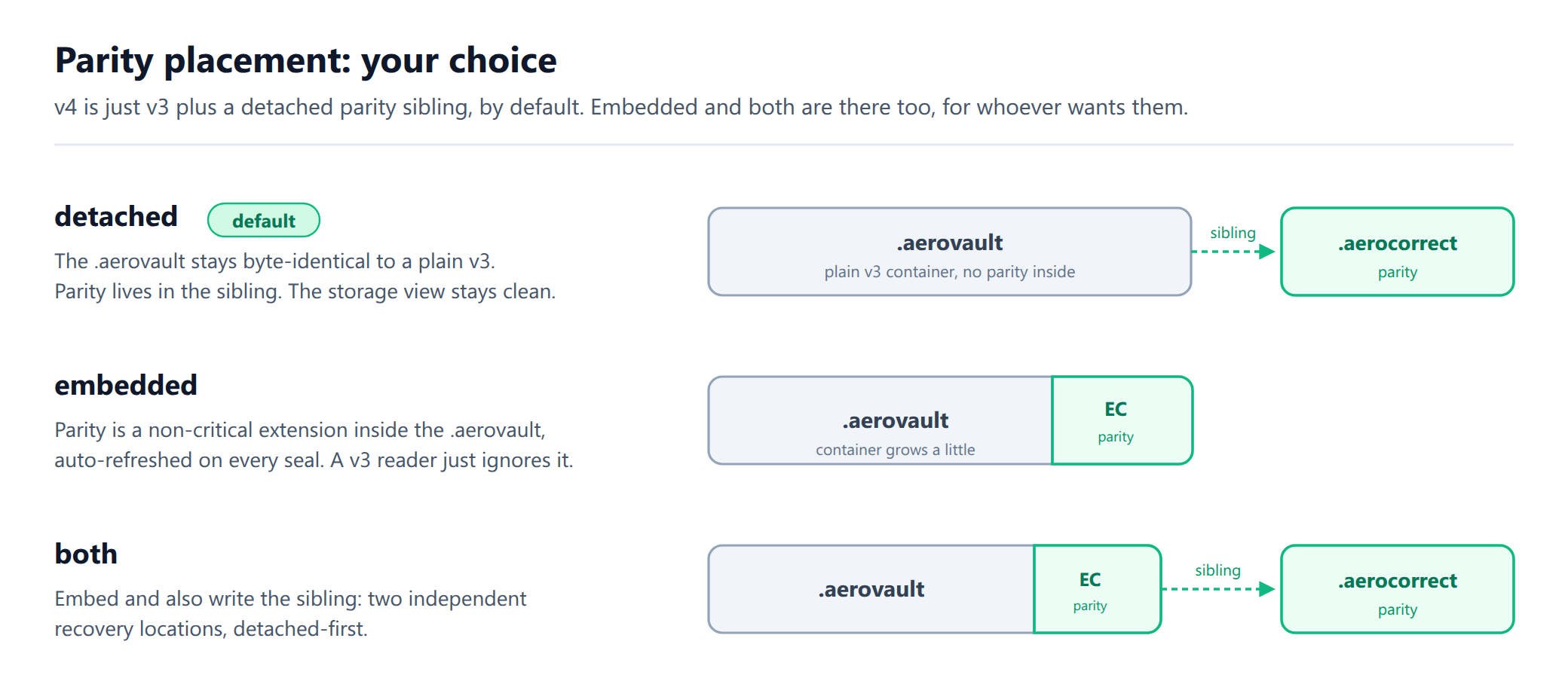
aerovault vault create my.aerovault --error-correction both

# Add files or a directory tree
aerovault vault add my.aerovault report.pdf photo.jpg
aerovault vault add-dir my.aerovault ./project --prefix work

# List, extract, info (all support --json)
aerovault vault ls my.aerovault -H
aerovault vault extract my.aerovault -o ./out
aerovault --json vault info my.aerovault

# Verify every block, then repair from parity if damaged
aerovault vault scrub my.aerovault
aerovault vault repair my.aerovault

# Add or refresh a detached recovery sidecar for an existing vault
aerovault vault export-parity my.aerovaultuse aerovault::{Vault, CreateOptions, EncryptionMode};
// Create a new vault
let opts = CreateOptions::new("secure.aerovault", "strong-password")
.with_mode(EncryptionMode::Cascade);
let vault = Vault::create(opts)?;
// Add files
vault.add_files(&["secret.pdf", "keys.txt"])?;
// Open and list
let vault = Vault::open("secure.aerovault", "strong-password")?;
for entry in vault.list()? {
println!("{} ({} bytes)", entry.name, entry.size);
}
// Extract
vault.extract("secret.pdf", "/tmp/")?;
// Rename in place (same parent directory)
vault.rename_entry("keys.txt", "keys-2026.txt")?;
// Move (works for files and directories)
vault.move_entry("secret.pdf", "archive/secret.pdf")?;
// Copy (works for files and directories)
vault.copy_entry("archive/secret.pdf", "backup/secret.pdf")?;use aerovault::{correct_generate, correct_repair, correct_verify};
fn protect_and_repair() -> Result<(), Box<dyn std::error::Error>> {
let report = correct_generate("my-vault.aerovault", 15, None)?;
println!("wrote {}", report.sidecar);
let verified = correct_verify("my-vault.aerovault", None)?;
if !verified.verified {
let repaired = correct_repair("my-vault.aerovault", None)?;
println!("status: {}", repaired.status);
}
Ok(())
}The current version is v4 = v3 container + Error Correction. See docs/AEROVAULT-V3-SPEC.md for the full v3 container specification (header, wrapper pipeline, manifest, extension directory, cryptography matrix) and the v4 Error Correction layer that rides on top of it. v4 is not a new on-disk major: the container stays v3 (magic AEROVAULT3, format = 3) and a plain v3 reader still opens a v4 container, skipping the non-critical Error Correction extension. The base binary layout that v3 builds on is in docs/AEROVAULT-V2-SPEC.md, and the detached recovery sidecar is in docs/AEROCORRECT-SPEC.md. See the CHANGELOG (0.4.0, 0.5.0) for the v3 and .aerocorrect deltas.
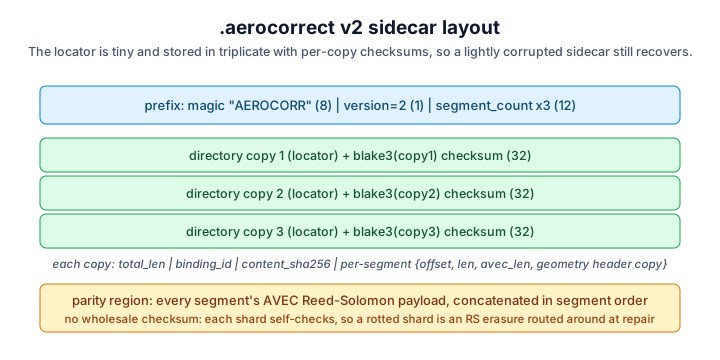
.aerocorrect is a detached, par2-style Reed-Solomon recovery sidecar for any byte stream. It protects the bytes of the target without embedding anything into it, so the same format repairs .aerovault containers, synced files, or ordinary standalone files. The sidecar binds to the SHA-256 of the protected content, not to a path, salt, account, or provider identity.
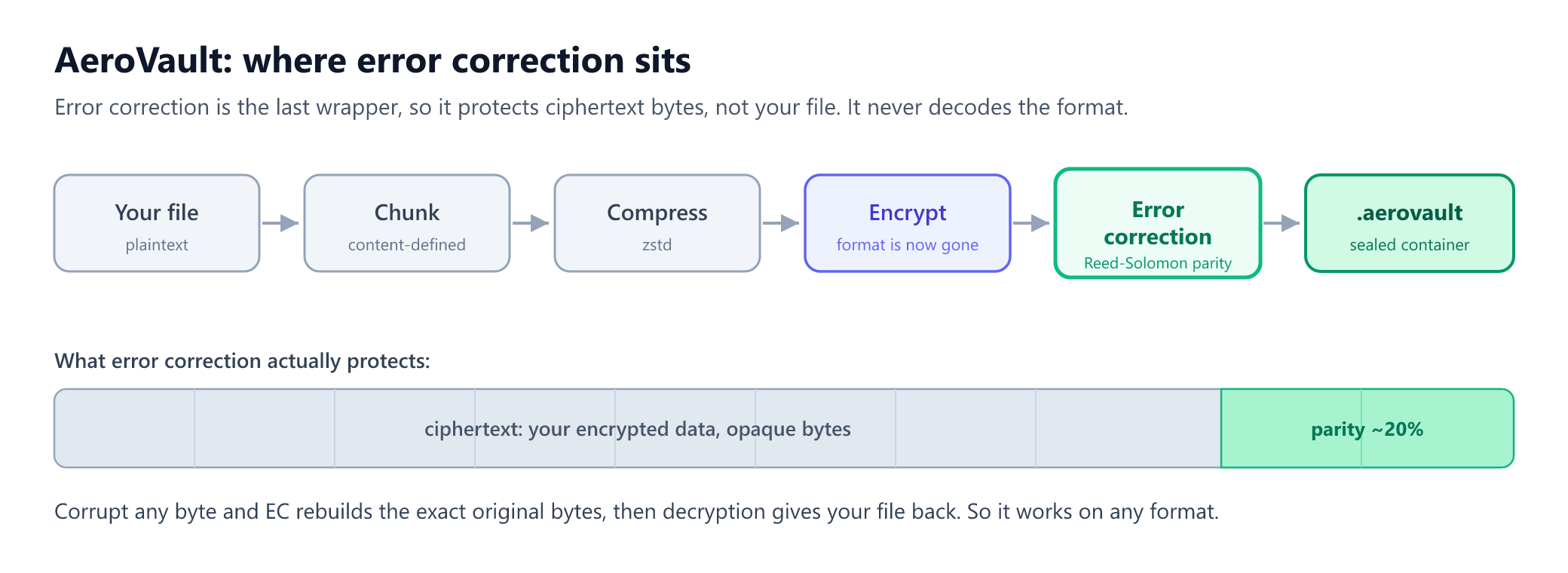
Error correction is the last wrapper in the AeroVault stack, so it protects the ciphertext bytes and never has to decode the format. For a .aerovault the parity lives in a sibling file by default, so the container stays byte-identical to a plain v3.
# Generate a detached recovery sidecar (writes report.bin.aerocorrect)
$ aerovault correct gen report.bin --ec medium
Wrote report.bin.aerocorrect (31543 bytes, 1 segment(s), 15 shards, 15.5% overhead) for report.bin

# Verify without modifying the file
$ aerovault correct verify report.bin
Verified: report.bin matches report.bin.aerocorrect

# ...after a 4 KiB run in report.bin is overwritten with zeros...
$ aerovault correct verify report.bin
Corruption detected in report.bin: run `correct repair` to recover from report.bin.aerocorrect

# Repair in place from the sidecar
$ aerovault correct repair report.bin
Repaired report.bin from report.bin.aerocorrect (1 shard(s) reconstructed)

$ aerovault correct verify report.bin
Verified: report.bin matches report.bin.aerocorrectCLI levels map to storage-overhead targets; the exact Reed-Solomon grid is stored in each payload, so readers reconstruct from the payload metadata rather than from a CLI-level assumption.
| Level | Target overhead | Reed-Solomon grid |
|---|---|---|
low |
~7% | approx K=14, P=1 |
medium |
~15% | approx K=13, P=2 |
quartile |
~25% | K=8, P=2 |
high |
~30% | approx K=7, P=2 |
| numeric | 5-50% | clamped into the supported range |
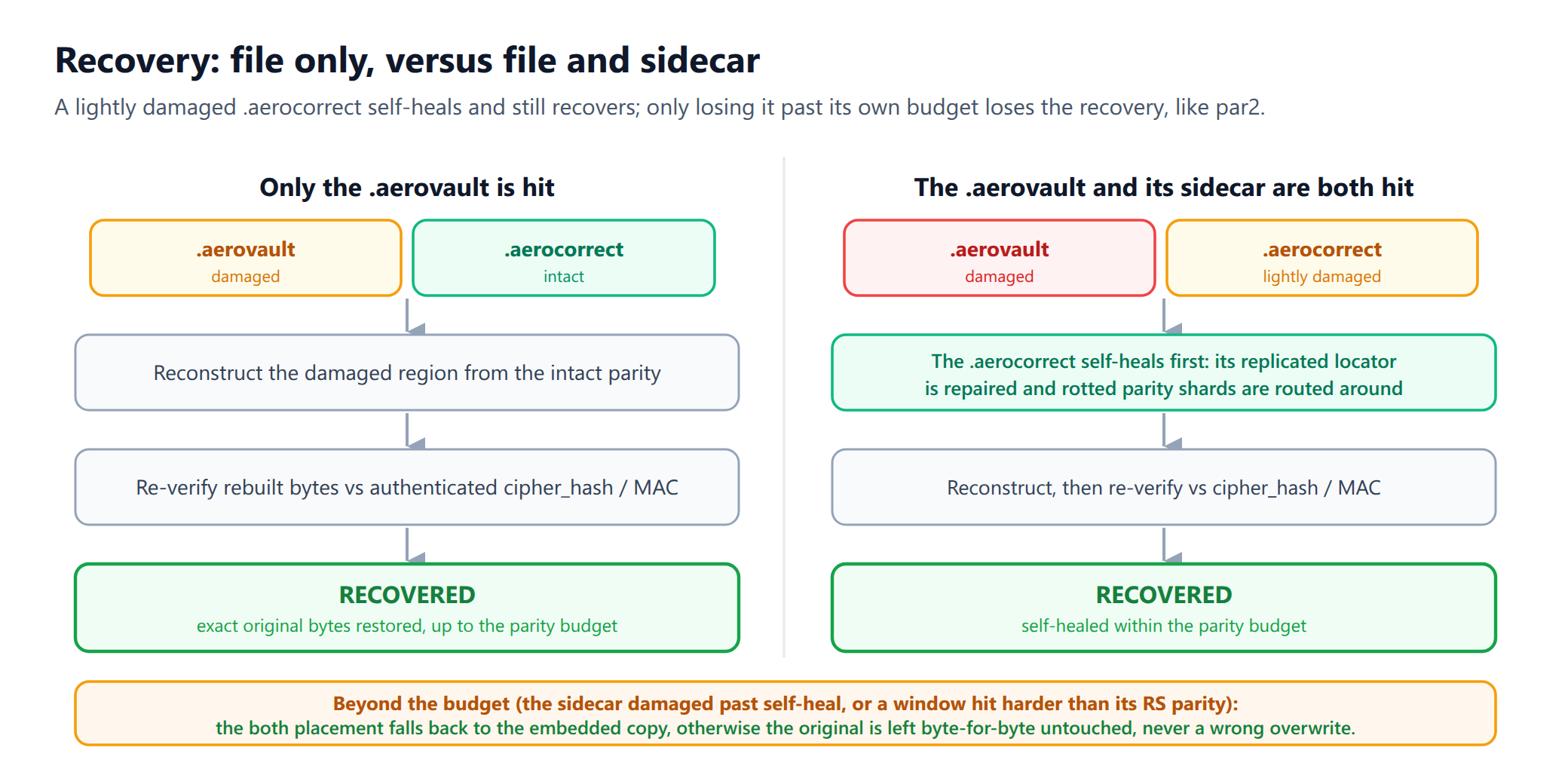
The small metadata that locates everything (the segment directory, content hash, and per-window geometry) is stored in triplicate with per-copy checksums, so a lightly-corrupted sidecar still recovers: a single rotted directory copy is detected and the read falls back to a good copy. The bulk parity carries no wholesale envelope checksum; every Reed-Solomon shard already carries its own checksum, so a rotted parity shard is treated as an erasure and routed around at repair time. (The pre-v2 framing used an all-or-nothing checksum that rejected any flip; v2 sidecars are written today, v1 sidecars are still read.)
Generation and repair run in 64 MiB windows and read sidecar parity on demand, so memory is bounded to one window plus that window's parity payload regardless of file size (the EC file cap is 1 GiB).
Repair is fail-closed and all-or-nothing: the rebuilt stream is re-verified against the bound content hash (and, for a vault, its authenticated header MAC / manifest cipher_hash) before the original is replaced. A corrupt or foreign sidecar can therefore only make a repair fail, never overwrite good data. The atomic temp-and-rename write means a crash mid-repair never leaves a half-written original.
| Surface | Reads | Writes |
|---|---|---|
| Vault container | v2, v3 | v3 |
.aerocorrect sidecar |
v1, v2 | v2 (self-healing) |
The .aerocorrect format is shared byte-for-byte with AeroFTP v4: a sidecar produced by either implementation verifies and repairs with the other for the same file and overhead level (a cross-implementation fixture pins this). See docs/AEROCORRECT-SPEC.md for the full binary layout.
| AeroVault (AEROVAULT3) | Cryptomator v8 | |
|---|---|---|
| Password KDF | Argon2id, 128 MiB / t=4 / p=4 | scrypt, N=2¹⁵ / r=8 / p=1 (~32 MiB) |
| Key hierarchy | HKDF-SHA256, domain-separated KEKs | HMAC-SHA256 derived subkeys |
| Master-key wrapping | AES-256-KW (RFC 3394) | AES-256-KW (RFC 3394) |
| Content cipher | AES-256-GCM-SIV (RFC 8452) | AES-256-GCM |
| Nonce-misuse resistance | Yes (synthetic IV) | No |
| Optional cascade | AES-256-GCM-SIV then ChaCha20-Poly1305 | No |
| Filename encryption | AES-256-SIV (deterministic) | AES-256-SIV (deterministic) |
| Cleartext chunking | Content-defined (gear-CDC, 256 KiB-4 MiB, ~1 MiB target) | Fixed 32 KiB |
| Compression | Per-chunk zstd | None |
| Deduplication | Keyed-BLAKE3 128-bit chunk ids | None |
| Chunk AAD binding | Block index + keyed chunk id | Chunk number + header nonce |
| Header integrity | HMAC-SHA512 (64-byte MAC) | Per-chunk GCM tag |
| Container format | Single .aerovault file (internal folder tree) |
Directory tree of encrypted files on disk |
| Error correction | Reed-Solomon .aerocorrect sidecar (rev. 4) |
None |
| Memory hygiene | Rust, zeroize + constant-time MAC |
Java/JVM (GC, no guaranteed key wipe) |
| Implementation | Rust | Java |
The KDF, cipher, wrapping and filename rows are shared by both container lineages; the chunking, compression, dedup and AAD rows describe the AEROVAULT3 container. The legacy AEROVAULT2 lineage uses fixed 64 KiB chunks with no compression and a per-file file_id AAD binding.
- All key material is zeroized after use
- Constant-time MAC comparison prevents timing attacks
- File-id-bound chunk AAD (current format) prevents chunk splicing and reordering
- Extraction opens outputs with
O_NOFOLLOW+create_newto refuse symlink redirection - Per-chunk lengths are bounds-checked before allocation
.aerocorrectrepair verifies the final SHA-256 before replacing the original- Atomic writes prevent corruption on crash
- 128 MiB Argon2id makes GPU brute-force impractical
GPL-3.0 -- See LICENSE for details.
AeroVault was originally developed as the encryption engine for AeroFTP, a professional FTP/SFTP/cloud client. This standalone crate makes the format available for any Rust project.
From the v3 format work onward, the AeroVault wrapper-stack pipeline model (the packing / chunking / chunk-id / compression / crypt / cipher-hash taxonomy) is a design contribution by Ehud Kirsh (E. Kirsh), AeroFTP issue #162, 2026. Ehud has also provided sustained community testing of AeroVault across releases. The wrapper-stack format itself is implemented in the AeroFTP application; this crate provides the stable v2 / current-format library it builds on.
